
- Reclamation
- California-Great Basin
- Golden Mussels
GOLDEN MUSSELS
The Bureau of Reclamation (Reclamation) takes the threat posed by golden mussels seriously. Key concerns include biofouling of infrastructure, threat to power generation and water delivery, difficulty of control/eradication, and ecological disruption. Reclamation is currently engaged in proactive surveillance, monitoring, and coordination activities with our operating and recreation managing partners to slow the spread and reduce risks to our water and power infrastructure, native ecosystems, and communities that we serve.
Overview
Invasive aquatic species like golden mussels are posing new and significant risks to California's water supply systems, hydropower facilities, ecosystems, and conveyance infrastructure. Following the first confirmed detection in the Sacramento-San Joaquin Delta in October 2024, Reclamation California–Great Basin Region (CGB) has expanded monitoring, coordination, prevention and response programs to safeguard public water resources from golden mussels.
What are Golden Mussels
Golden mussels (Limnoperna fortunei) are small freshwater bivalves native to Southeast Asia. They reproduce rapidly and form dense colonies that attach to hard surfaces such as rocks, pipes, and watercraft. Compared to zebra mussels (Dreissena polymorpha) and quagga mussels (Dreissena rostriformis bugensis), golden mussels can reproduce more rapidly throughout the year and colonize a wider variety of surfaces. Golden mussels can also alter ecosystems more aggressively by reaching higher densities and tolerating a broader range of environmental conditions (e.g., water temperature and salinity levels).
- Shell color ranges from golden to yellowish-brown
- Typical size: 2-3 cm (up to 4 cm)
- Colonies can exceed 200,000 mussels per square meter
- Larvae ("veligers”) disperse through water currents Tolerant of wide temperature ranges, low oxygen, and moderate salinity
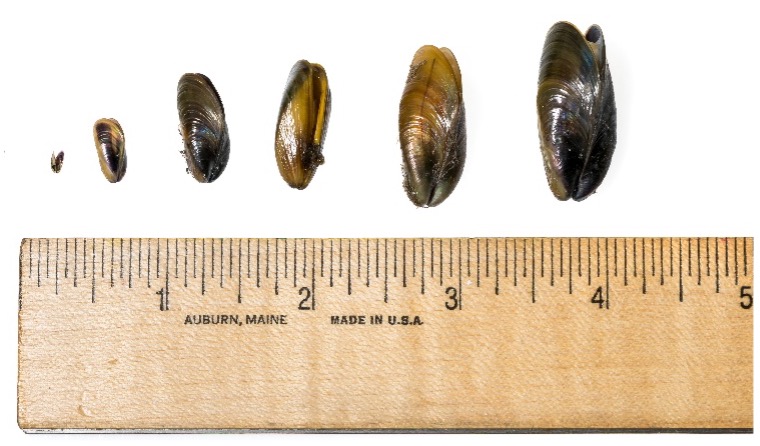
Example size of golden mussels. Photo source: CA Department of Water Resources
Current Status in California
Since the initial 2024 discovery, golden mussels have been confirmed in several interconnected water systems within Reclamation’s Central Valley Project (CVP) and the California’s State Water Project (SWP), including:
- O’Neill Forebay (CVP/SWP joint-use)
- Tracy Fish Facility louvers
- Pleasant Valley Pumping Plant discharge pipeline
- Contra Costa Water District intake and distribution components
- The Friant–Kern Canal
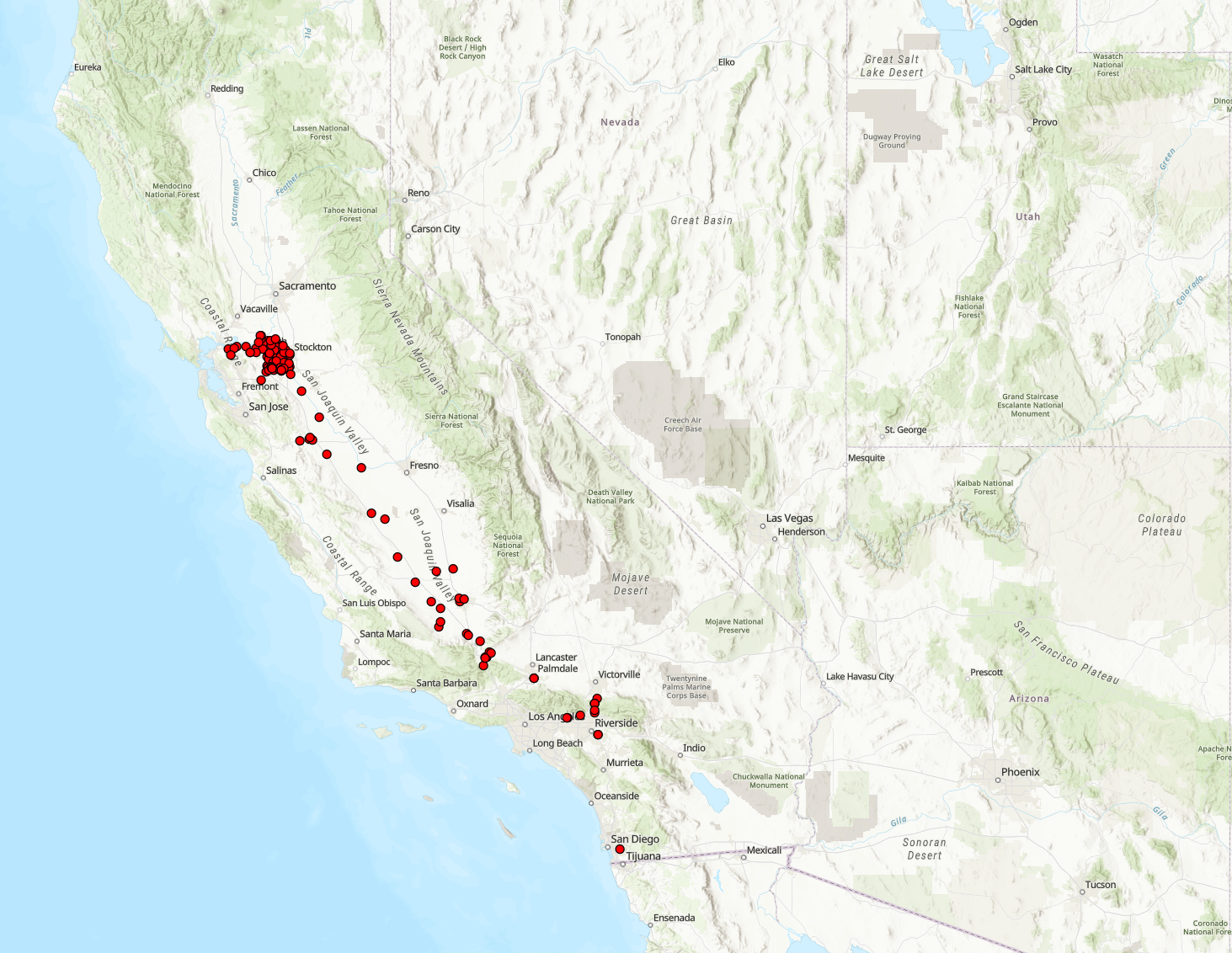
Golden mussel survey map – Source CA Department of Fish and Wildlife
Why Are Golden Mussels a Threat?
Golden mussels spread quickly and can overwhelm both natural waterways and the systems that deliver water and power throughout California. Once they attach to structures or equipment, they multiply rapidly and cause serious problems for communities, ecosystems, and critical infrastructure. The invasive species also:
- Block water flow – Mussel colonies clog pipes, screens, pumps, and canals, reducing how much water can move through the system.
- Damage water and power facilities – They attach to valves, gates, hydropower equipment, and cooling systems, causing mechanical failures and costly repairs.
- Increase maintenance needs and costs – Facilities must clean and treat equipment more often to stay operational.
- Reduce hydropower efficiency – Fouled components make power generation less effective.
- Disrupt local ecosystems – Golden mussels filter large amounts of water, remove plankton and alter the food webs for dependent fish and other aquatic species.
- Outcompete native species – They crowd out native mussels and other aquatic life.
- Affect agriculture and communities – Reduced water flow and increased infrastructure issues can limit water available for farms and municipalities.
- Recreational nuisance – By colonizing surfaces along boat launches, shorelines, and beach areas. Accumulation of broken shells in these higher-use areas increases risk of skin injuries to recreators.
- Lower water quality – Their waste can increase nutrient levels and contribute to harmful algal blooms.
- Spread easily – Larvae drift with currents, and adults can cling to boats and equipment.
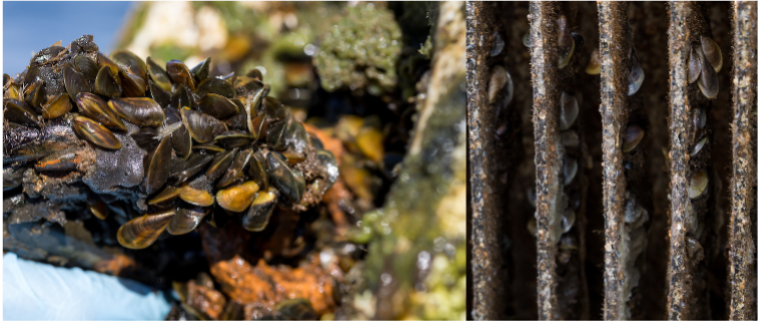
Golden Mussels attached to infrastructure. Photo: CA Department of Water Resources
Reclamation’s California Great Basin Regional Response
Reclamation uses a region-wide, multi-layered strategy to manage golden mussel spread:
- Enhanced monitoring of CGB reservoirs, canals, and infrastructure
- Monthly facility assessments and detection reporting
- Interagency coordination with state, federal, and local partners
- Research and evaluation of biological, mechanical, and chemical control methods
- Public education emphasizing prevention and awareness
More information: Golden Mussel Response Framework - & Golden Mussel Task Force Steering Committee
Halt the Hitchhiker: Invasive Species Challenge
Reclamation is sponsoring a 3-phase prize challenge (managed by yet2) for innovative solutions to eliminate the risk of aquatic invasive species (AIS) being transported in raw water entering and exiting watercraft ballast compartments. The goal is to identify novel approaches that can kill, exclude, or inactivate AIS such as quagga, zebra, and golden mussels, thereby protecting Reclamation's water delivery and hydropower infrastructure.
For more information and to submit your innovation visit: Halt the Hitchhiker: Invasive Species Challenge
How the Public Can Help
You can help prevent the spread of golden mussels by following these simple steps:
- CLEAN all equipment before leaving the waterbody
- DRAIN bilges, live wells, and all standing water
- DRY boats
- INSPECT boats and trailers before launching
- REPORT an invasive species sighting – Report organisms observed in California suspected to be golden mussels to California Department of Fish and Wildlife’s Invasive Species Program.
- KNOW BEFORE YOU GO – Contact the managing agency of the waterbody you plan to visit for launching requirements and potential closures.
Protecting California Great Basin’s Water & Power Infrastructure
Golden mussels present a growing challenge for water resource managers in California. With early detection, coordinated mitigation, and strong public participation, the Reclamation remains committed to protecting water infrastructure, ecosystems, and the communities that depend on them.
Additional Resources
Lake Berryessa
- Lake Berryessa implements new protocol for boat launching
- Markley Cove
- Pleasure Cove Marina
- Putah Canyon Campground
- Gone Fishin’ Marine
For additional questions contact: BOR-Berryessa@usbr.gov and/or decon@SCWA2.com
New Melones
Folsom Lake
- Golden Mussel Prevention Program Mandatory Decontamination, Quarantine and Inspection
- Golden Mussel Prevention Program Inspections/Seal Program FAQs
Partner Agencies & Resources
- Solano County Water Agency
Lake Berryessa Mussel Prevention Program | Solano County Water Agency - California Department of Water Resources (DWR):
Invasive Mussel Mitigation - State of California
Final GM Framework 072225 ADA - California State Parks – Division of Boating and Waterways
Golden Mussel Prevention Program FAQs
Quagga, Zebra, and Golden Mussels
- California Department of Fish and Wildlife (CDFW)
California’s Invaders: Golden Mussel Golden Mussel
Fact Sheet_rev05282025 - U.S. Forest Service (USFS)
Pacific Southwest Region | Help Halt Golden Mussel Invasion | Forest Service
Invasive Mussel-Free Certification - U.S. Fish and Wildlife Service (USFWS)
ERSS - Golden Mussel (Limnoperna fortunei) - State of California DMV
Mussel Fee Sticker Request - California DMV
For more general information contact: ismith@usbr.gov or mlowe@usbr.gov
For media queries contact: sha-MPR-PublicAffairs@usbr.gov
